U-Haul® Truck User Instructions
by 
U-HAUL ROADSIDE ASSISTANCE
Obtén ayuda en uhaul.com/help/
o llama al 1-800-528-0355
LAS 24 HORAS DEL DÍA, LOS 7 DÍAS DE LA SEMANA
Download and print this guide:English | Français | Español
Símbolo de alerta de seguridad : este símbolo de alerta
precede a todos los mensajes de seguridad de estas instrucciones. Los mensajes de seguridad te alertan sobre posibles peligros y te explican cómo evitar o reducir el riesgo de lesiones.
 ADVERTENCIA
READ and FOLLOW all of these instructions and safety messages before operating the truck. Tú, tus pasajeros u otras personas en la carretera pueden sufrir MUERTE, DESMEMBRAMIENTO O LESIONES GRAVES si no sigues estas instrucciones. Asegúrate de que todos los conductores lean y entiendan todas estas instrucciones.
Parking, backing and loading
ALWAYS SET THE PARKING BRAKE when parking. Firmly set the parking brake and then move the shift selector firmly into park. ALWAYS TURN ENGINE OFF before exiting cab. When facing downhill, turn the wheels toward the curb. When facing uphill, turn the wheels away from curb.
GET HELP BEFORE YOU BACK UP There are blind spots behind any vehicle. DO NOT rely on mirrors alone. Have the helper stand where he can be seen directly, or in your mirror, while he guides you. He should not be in the path of the truck. If no help can be found, walk around the rear of the truck and MAKE SURE there are no children, pedestrians or obstructions behind you.
DO NOT HOLD THE RAMP or have the ramp extended while the truck is BACKING UP or in motion.
NEVER overload the truck. No excedas la clasificación de peso bruto del vehículo (GVWR, por sus siglas en inglés) y las clasificaciones de peso bruto por eje (GAWR, por sus siglas en inglés), que están colocadas en una etiqueta dentro de la abertura de la puerta del conductor.
NEVER load cargo on the outside of the truck.
DO NOT transport hazardous materials, corrosives, explosives or flammables.
NEVER leave CHILDREN or KEYS unattended in the truck.
Disturbances and emergency situations
A “disturbance” is improper handling, oversteering or other deviation of the truck from its intended path, due to one or more causes (improper loading, steering inputs, excessive speed, crosswinds, passing vehicles, rough roads, tire blowout, trailer sway or whipping, etc.).
If a DISTURBANCE OCCURS, DO NOT steer or brake. Let off the gas pedal to slow down. Mover el volante o frenar durante una perturbación puede causar una pérdida de control o un choque.
Si una RUEDA SE SALE DE LA CALZADA PAVIMENTADA, NO gires bruscamente y NO frenes . Suelta el pedal del acelerador y reduce la velocidad por debajo de las 25 mph. A continuación, gira gradualmente de vuelta a la calzada. Procede con precaución al entrar en el tráfico.
Slow down
EVITA LOS CHOQUES reduciendo la velocidad. Reduce your speed from what you would normally drive your car under similar road conditions.
DRIVE DEFENSIVELY – anticipate stops, brake early and never follow closely.
BEFORE going downhill, slow down and shift the transmission into a lower gear. DO NOT RIDE BRAKES on downgrade
Reduce la velocidad en las curvas, el clima adverso, las condiciones peligrosas de la carretera, la construcción de carreteras y las salidas de autopistas.
While on the road
Usa la lista de verificación que se encuentra al final de estas instrucciones antes de remolcar o mientras viajas.
Usa SIEMPRE el cinturón de seguridad. Asegúrate de que los niños estén bien sujetos.
Rear-facing infant seats should never be placed in the front seat of a truck equipped with a passenger side air bag. A child may be seriously injured if an activated airbag strikes the child restraint.
NO conduzcas cuando estés fatigado, somnoliento o distraído. Evita conducir de noche.
NUNCA uses el teléfono celular mientras conduces. If you need to use a cell phone, find a safe place to exit the roadway.
NUNCA conduzcas bajo la influencia del alcohol o cualquier sustancia que pueda afectar tu visión, juicio o capacidad para controlar el vehículo.
NEVER allow passengers to ride in the cargo area or on the truck exterior. Los pasajeros corren el riesgo de sufrir lesiones debido al desplazamiento de la carga, la asfixia y la falta de protección contra colisiones.
EXHAUST FUMES ARE LETHAL. DO NOT operate the engine in a confined area where exhaust fumes could enter through doors or windows. DO NOT sleep in the truck with the engine running.
Overhead clearance
U-HAUL TRUCKS ARE TALLER THAN PASSENGER CARS. If you don’t know the overhead clearance, get out of the truck and make certain that you are clear of any obstruction. DO NOT GUESS.
Watch out for drive-through restaurants and motel overhangs, service-station canopies, bridges, balconies, roof eaves, porch awnings, electrical wires and tree limbs. Many overhead obstructions are not posted for clearance.
Carga
Load heavy items first
Load the heaviest items first, in front and on the floor. Load lightest items last, on the top and to the rear. Pack all items closely and firmly. Secure partial loads with rope, as close to the front of the cargo area as possible. NEVER load cargo on the outside of the truck. Asegúrate de que la puerta de cargamento esté cerrada y trabada de forma segura.
No sobrecargues
Every U-Haul truck has a maximum (fully loaded) gross weight label on the driver’s side doorpost. NEVER load the truck so that it exceeds the listed GVWR and GAWR. If in doubt, check the weight on a commercial or state scale. To check GVWR and GAWR weigh the truck with; full fuel tank, all occupants, all cargo and trailer tongue weight if towing.
Remolques
Most U-Haul trucks are fully equipped to tow a trailer. If you plan to tow a U-Haul trailer, you will be provided with the appropriate equipment and instructions. Read the U-Haul Trailer User Instructions thoroughly. Follow the instructions on how to properly load and operate your truck/trailer combination.
If you plan to tow your own trailer, check with a U-Haul representative to determine the maximum trailer weight you can tow. Make sure your trailer is properly loaded, that the coupler and safety chains are attached and that the trailer lights are working properly. See your trailer owner’s manual for more information.
Materiales peligrosos
DO NOT transport hazardous materials, corrosives, explosives or flammables, such as gasoline or paint thinner. Un contenedor casi vacío es tan peligroso como uno lleno. Los objetos inflamables pueden explotar o encenderse a través de la combustión espontánea del movimiento del vehículo.
Vacía y ventila los tanques de las cortadoras de césped, las estufas de camping y las linternas antes de cargar.
NEVER fill a portable fuel container IN or ON the truck. Coloca los tanques en el suelo al llenarlos para evitar la electricidad estática y evitar chispas.
Cierra de forma segura y empaca correctamente los productos de limpieza del hogar.
Loading ramps
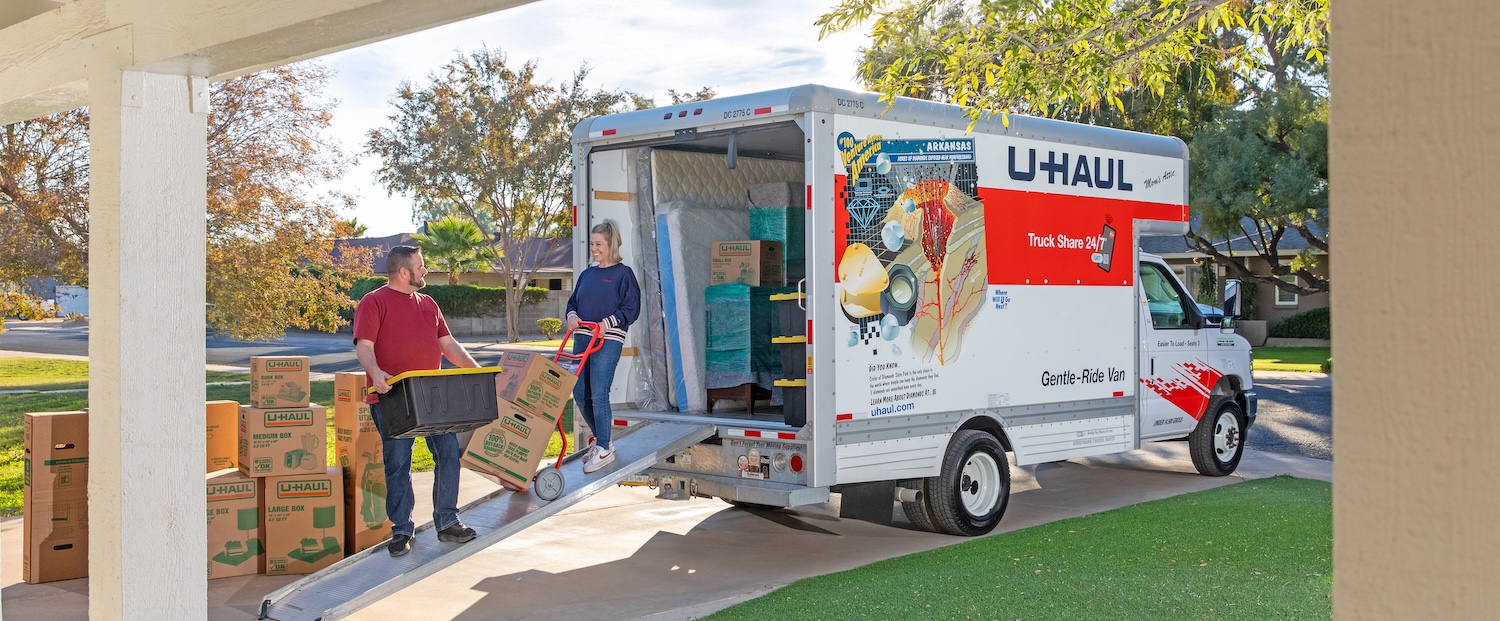
U-Haul designed the loading ramp to help you load and unload the truck. MAKE SURE the loading ramp is completely stored and latched before you put the truck in motion. Follow ramp operating instructions on the decal in the cargo area of the truck.
Footwear
When loading or driving a U-Haul truck wear fully enclosed shoes with slip-resistant soles, such as tennis shoes or work shoes. Flip-flops and sandals do not provide protection from falling objects or sharp edges of your cargo. You are also more likely to slip and fall when wearing flip-flops or sandals.
Wet floors
If the floor of the cargo box or the loading ramp become contaminated (wet, oily, other), remove all contaminate from that surface. You may slip and fall when walking on a contaminated surface.
Conducción
Get familiar with controls first
Before driving, familiarize yourself with the driver controls and accessories. Be sure you understand how to operate the transmission shift and parking brake controls before starting engine. Locate the switches for lights, wipers, climate controls, etc. Adjust mirrors as needed.
Distancia de parada y seguimiento
U-Haul trucks are heavier than passenger cars, especially when loaded. Esto significa que tardará más en detenerse.
Mantén una distancia de al menos 4 segundos con respecto al vehículo que va delante de ti. Comienza a contar cuando la parte trasera del vehículo de adelante pase por un objeto fijo, como una línea o grieta en la carretera. Si la parte delantera de tu vehículo alcanza el objeto antes de que finalicen los 4 segundos, aumenta la distancia.
Si estás conduciendo en condiciones climáticas adversas, como lluvia, nieve o niebla, usa al menos un espacio de 5 segundos.
If a disturbance occurs:
Suelta el pedal del acelerador. NUNCA aceleres para tratar de controlar una perturbación combinada.
NO frenes.
SOSTÉN EL VOLANTE en posición recta. DO NOT try to control the combination disturbance by turning the steering wheel.
After a disturbance has stopped:
Aléjate a una distancia segura de la calzada y detente. Get all occupants out of the truck and away from the roadway.
Check the cargo to make sure the load has not shifted. Make sure the truck is loaded heavier in front and not overloaded.
Verifica que todos los neumáticos estén inflados correctamente y que todas las tuercas estén apretadas.
If towing a trailer, make sure it is properly loaded. Trailers must be loaded heavier in the front half to prevent trailer sway or WHIPPING. See the U-Haul Trailer User Instructions for more information.
If the disturbance persists, contact the nearest U-Haul representative and have them inspect or exchange the truck.
Rebasado
Your truck is heavier and longer than a passenger vehicle and will require more time and distance to pass. DO NOT pass on hills or curves.
Pendientes
Shift into lower gears to prevent the truck from jerking due to engine lugging when traveling up hills. Esto mejorará el consumo de gasolina y reducirá el sobrecalentamiento del motor.
DO NOT ride the brake pedal while going downhill. El uso prolongado de los frenos provoca un sobrecalentamiento y una posible pérdida de frenado. Cuando necesites reducir la velocidad, pisa el pedal del freno y reduce la velocidad por debajo de la velocidad prevista. Then let completely off the brake pedal. Repeat this braking cycle as needed.
Arcenes de carretera
Si una rueda se sale de la calzada pavimentada:
NO gires el volante bruscamente.
NO frenes.
Suelta el pedal del acelerador y reduce la velocidad por debajo de las 25 mph. A continuación, gira gradualmente para volver a la carretera. Procede con precaución al entrar en el tráfico.
Esquinas pronunciadas
Evita girar bruscamente en esquinas, gasolineras o estacionamientos. Because the truck is longer the truck rear end will track inside the turn and may sideswipe a vehicle or object. Conduce un poco más allá de la esquina antes de girar o gira más de lo que lo harías con un automóvil para evitar esto. O simplemente planifica con anticipación y evita los giros bruscos siempre que puedas.
Steep driveways
When driving on steep driveways or angled incline transitions, the rear bumper may drag or get stuck, particularly after loading. The parking brake also may not hold on excessively steep inclines. Avoid driving or parking on steep inclines, park in an alternate location.
If truck gets stuck
If truck becomes stuck in snow, mud, sand, other; do not attempt to get it out by spinning wheels or revving engine – this may damage the truck and you will be held responsible. Get help at https://www.uhaul.com/help/ or call the Roadside Assistance number under BREAKDOWNS below, and U-Haul will assist you.
Servicing-truck
Refueling
Shut off engine before refueling. Extinguish all smoking materials and open flames. Remove fuel-tank cap slowly to vent any pressure inside the tank.
Avoid spilling fuel. Hot engine exhaust can ignite flammable vapors, causing a fire or explosion.
Be sure to use correct fuel, refer to labeling on truck.
Presión de los neumáticos
Coloca la presión adecuada a todos los neumáticos. Find the recommended COLD pressure on the tire decals located on the truck. La presión de los neumáticos aumenta durante la conducción. NO dejes escapar esta presión adicional.
Engine oil
You should check engine oil at each fuel stop. Use only the grade of oil that is listed on the decal in the engine compartment. Keep the engine oil level between the ADD and FULL marks. Save receipts for reimbursement when you return your truck.
If your truck is equipped with a tilt engine hood, pull it open only from the front handle.
Coolant
NEVER loosen the radiator cap when engine is HOT. Doing so can cause HOT coolant to spray out under pressure. Check radiator level only when engine is COLD.
Averías
Immediately park your truck in a safe place, completely off the roadway. Enciende las luces intermitentes de emergencia. Saca a todos los ocupantes del vehículo y aléjalos de la calzada.
Assemble and place the emergency warning triangles on the roadway, as traffic permits. Assembly and placement instructions are shown behind passengers seat, or on the back of the passenger-side visor.
Si debes continuar por la carretera para llegar a un lugar seguro fuera de la carretera, enciende las luces intermitentes de emergencia y procede con precaución.
Si es necesario, conduce con una llanta desinflada para llegar a un lugar seguro completamente fuera de la carretera. Conduce despacio.
If the truck’s mechanical problem is minor and it can be safely driven, proceed to the nearest U-Haul location, get help at https://www.uhaul.com/help/ or call Roadside Assistance at 1-800-528-0355.
If the mechanical problem is major or if the truck is inoperable or cannot be driven safely, get help at https://www.uhaul.com/RoadsideAssistance/or call Roadside Assistance at 1-800-528-0355. Prepárate para dar tu ubicación exacta y un número de teléfono para devolver la llamada. Ten el contrato contigo al llamar. Un representante de U-Haul se comunicará contigo y hará lo que sea necesario.
Accidentes
En caso de accidente, saca a todos del vehículo y de la carretera. Llama a una ambulancia si alguien está herido. Notify the police as soon as possible and then report the accident at https://www.uhaul.com/help/ or call Roadside Assistance at 1-800-528-0355.
Driving checklist
(Úsala en cada parada)
Antes de conducir
- Fasten safety restraints.
- Posiciona correctamente los espejos.
- Get familiar with controls.
Backing and loading
- Before backing, check behind the truck for pedestrians and obstructions.
- Secure load in cargo area.
- Cargo door closed and latched securely.
En la carretera
- Slow down to avoid crashes
- Anticipate stops. Brake early.
- Be alert and drive defensively.
- Stop for rest when you get tired.
At stops
- Firmly set parking brake.
- Shift transmission firmly into park and turn engine off.
- Check connections if towing a trailer.
- Check tire condition.
- Check that all lights are working.
- Remove keys and lock the truck.
Remember – crashes are caused by:
- Error o falta de atención del conductor.
- Velocidad excesiva.
- Following too closely.
Siempre debes:
- Load the truck heavier in front.
- Reducir la velocidad a la que conduces normalmente.
- Usar el cinturón de seguridad.
For more than 80 years, orange has been an iconic and recognizable color in moving and storage, signifying U-Haul products and services and the quality, affordability, and convenience they provide.